
Answering the "Ever" Question on the Decision Tree: Key Points and Practice Scenarios
- Facilitator Guide (PDF)
- Practice Scenarios Handouts (PDF)
- Participant Materials (PDF)
- Participant Materials (MS-Word)
- Participant Workbook (MS-Word)
The Child Outcomes Summary (COS) Learning Community created this resource to provide key points and practice scenarios for team decision-making when answering the first question on the Decision Tree for Summary Rating Discussions during the COS process.
The practice scenarios can be used by individuals in a self-directed format, or to support team building and shared understanding. Facilitators and participants should be familiar with the essentials of the COS process as outlined in the COS Process Module.
Key Points
The "Ever" Question on the Decision Tree
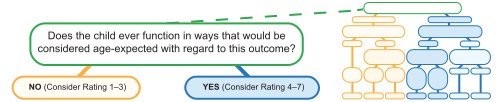
Teams must discuss specific examples of the child's functioning within the outcome area being rated. By sharing examples, teams better understand the child's functioning and reach consensus.
"Ever" means that the child has an age-expected (AE) skill in their repertoire and uses it in a meaningful way with some consistency—at least occasionally—even if it is not observed in every setting or situation.
"Ever" does not mean everything the child does in an outcome area is AE. It also doesn't mean the child has performed an AE skill at one single time or at any one point in their lives.
Gather Input and Discuss Examples
Rely on the team—with family input—to answer the "ever" question in each outcome area. Discuss examples of the child's functioning from different sources and team members. Determine if the examples are descriptive enough to convey the child's functioning within the outcome area being rated:
- Across the breadth of this outcome area.
- Across different settings and situations.
Age Anchoring Discussions
Practice quality age anchoring to reference how close or far a child's functioning is to age expectations by:
- Discussing what the child is doing and what is AE for that skill. This includes if the child is doing those things and what degree of support is needed. Referencing functional skills expected for the child's chronological age, as opposed to those skills that come in earlier and remain throughout development, for example, maintaining eye contact.
- Avoiding dwelling on discrete or isolated demonstrations of a skill as opposed to considering other examples.
- Ensuring evaluation results or any diagnosis does not over-influence the team's consideration of all skills in one of the Three Child Outcomes.
Demonstrating a skill during an evaluation does not mean it is not functional or "doesn't count," especially if the child has not had sufficient opportunity to demonstrate the skill in everyday settings or has achieved functional use of the skill at an AE level.
Tipping
Tipping is a metaphor for having sufficient information to determine if a child's functioning is AE or not. On the Decision Tree for Summary Rating Discussions, sufficient information tips toward the No side of the tree if there are no examples of AE functioning and toward the Yes side if there are examples of AE functioning. When the information provided lacks a clear result teams may reasonably conclude that the information is Not Tipping toward either side.

No, Clearly Not Age-Expected
There is no instance of AE functioning in this outcome area.
The team cannot identify any examples of the child functionally using skills that developmentally emerge near this child's current chronological age across all the skills related to this outcome area.
The skills the child is using are clearly at a foundational (F) or immediate foundational (IF) level.

Not Tipping
Some aspect about the skill the team is considering—its quality, consistency, level of support provided, the child's health, or cultural issues around opportunities and expectations—makes it questionable, so it should not count as the only example of a functional AE skill on the outcome.
If an example is unclear, teams should not overthink, but instead think of other examples across the breadth of the outcome that might provide clarity.

Yes, Clearly Age-Expected
The team can identify example(s) of the child functionally using skills that are expected at the child's current chronological age. There is at least one instance of AE functioning in this outcome area.


These contents were developed under a cooperative agreement, #H326P220002, and a grant, #H373Z190002, from the Office of Special Education Programs, U.S. Department of Education. However, the content does not necessarily represent the policy of the U.S. Department of Education, and you should not assume endorsement by the Federal Government.
ECTA Center Project Officer: Julia Martin Eile
DaSy Center Project Officers: Meredith Miceli and Amy Bae