
Systems
Each state's early intervention and early childhood special education system is comprised of interconnected parts that work together to support the provision of high-quality services at the local level. The system is set up to ensure services and supports are provided for young children with disabilities and their families served under the Individuals with Disabilities Education Act (IDEA).
How do systems, practices, and outcomes work together?
The state's system is responsible for critical functions that promote effective practice at the local level—for example, establishing personnel requirements, planning for a financially-sound system, providing policy and procedural guidance, and delivering technical assistance to support high-quality local programs and personnel. The local programs are responsible for implementation of effective-based practices aimed at achieving positive outcomes for young children with disabilities and their families as required under the Individuals with Disabilities Education Act (IDEA).
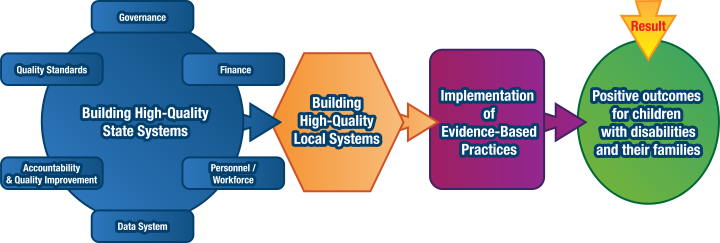
System Components
A state's infrastructure has multiple components that work together to ensure that the system functions effectively and supports the implementation of high-quality early intervention and early childhood special education services. Each component has a specific role and activities that influences and impacts the work of other components. All must function together effectively to have a high-quality system, as outlined in the ECTA System Framework.
State Systemic Improvement Plan (SSIP)
All states are required under IDEA to develop a State Performance Plan (SPP) and Annual Performance Report (APR). The SPP and APR evaluate the state's efforts to implement the requirements and purposes of IDEA. The SPP and APR include indicators aimed at improving results for young children with disabilities and their families, including indicators that measure child and family outcomes.
Other indicators measure a state's compliance with the requirements of the IDEA. An additional indicator—the State Systemic Improvement Plan (SSIP)—is a comprehensive, ambitious, yet achievable multi-year plan developed by states aimed at improving results for children with disabilities and their families.
Inclusion
Early childhood inclusion embodies the values, policies, and practices that support the right of every infant, toddler, and preschooler and his or her family, regardless of ability, to participate in a broad range of activities and contexts as full members of their community.
The aim is that all young children with disabilities have access to high-quality inclusive settings, are provided supports to fully participate in play and learning activities with their peers, and that programs have appropriate system supports in place to implement high-quality inclusive practices.
The language in Part C of IDEA refers to the same values of inclusion as services being delivered in natural environments. Early intervention and early childhood special education systems should be designed to support services in natural and inclusive environments.
Systems Related Topic Pages
- System Framework
- Child Find for Young Children with Disabilities
- Expulsion and Suspension in Early Childhood
- Family Engagement
- Finance
- General Supervision of State Part C Systems
- Inclusion
- Personnel Development
- Procedural Safeguards: Family Rights, Confidentiality, and Dispute Resolution
- Quality Rating and Improvement Systems (QRIS)
- State Systemic Improvement Plan (SSIP)